Thursday, 27 June 2013

Test Space heads to Nancy Victor

Test Space will be exhibiting 'Found' at Nancy Victor from Wednesday 31st July - Monday 19th August. 

Found and recycled objects hold personal histories and interactions which can be used and built upon to create a new life, new associations or narrative. Each exhibiting art work has been painted, sprayed or built onto found materials, be it skate decks, tree stumps, speakers or baseball bats.

The exhibition shows work by a selection of artists Test Space have worked with previously, alongside a number of artists who were invited to exhibit including: Benjamin Murphy, Pogger, Ferres, Suzko, International Nobody, SixOneSix  and Captain Kris. 

Test Space is a creative agency established in 2010, developing innovative and new ways to showcase artists and their work, often making use of temporary, unusual and abandoned property to do this. 

Join us for the opening on Thursday 1st August from 6.30-8.30pm

Monday, 17 June 2013

The Stories of Food by Mary Dalton

The Stories of Food, print maker Mary Dalton's debut solo show at Nancy Victor opened at the weekend. There was a tasty selection of cakes and tea to welcome those out of the rain. Monoprints, etchings, wood cuts and textile make this an exciting yet dark exhibition about an essential for every day life.   

Seed Watching, 2012

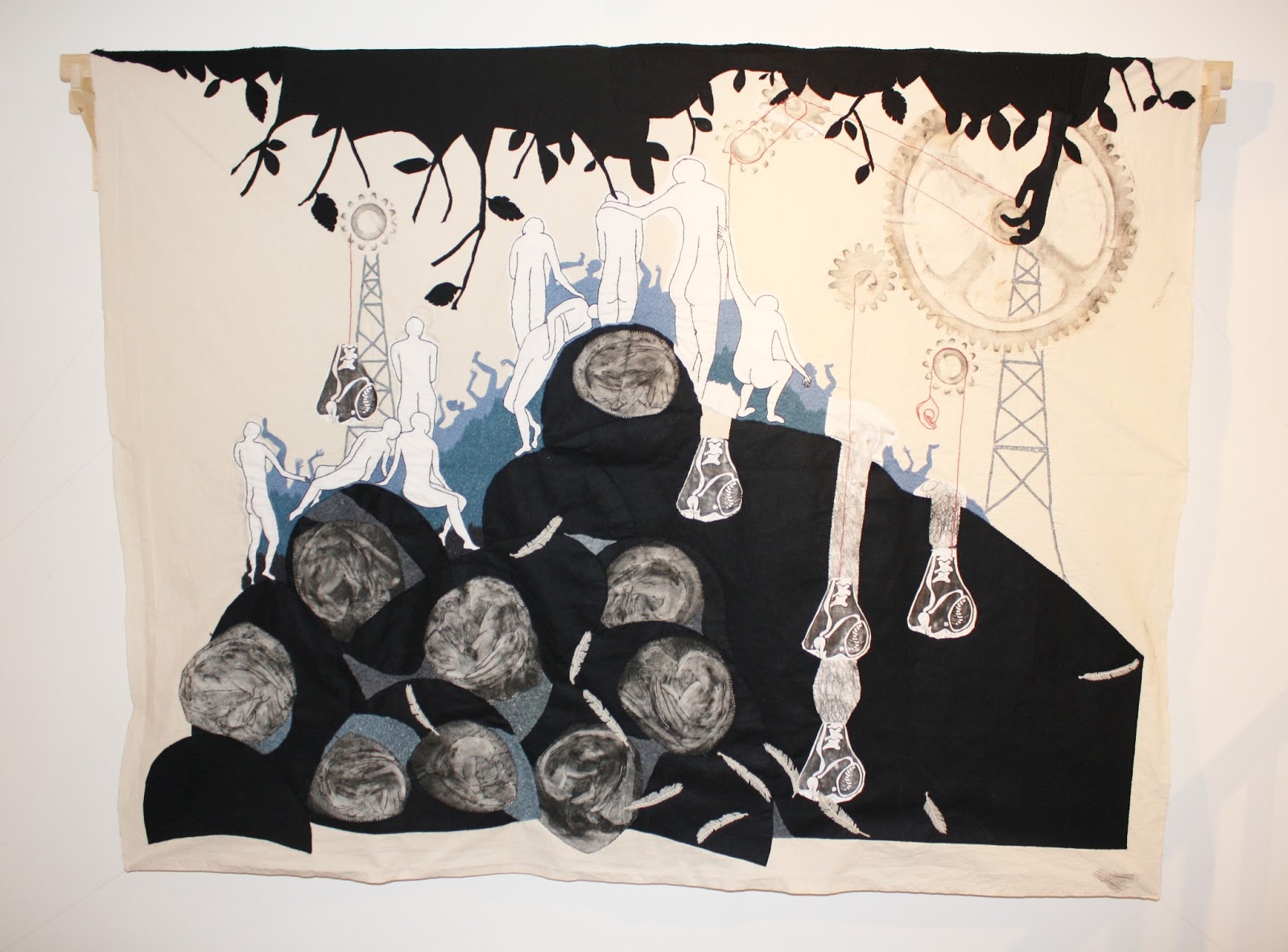
Mary Dalton's work is enthused and inspired by food, what it means to us and how we treat and consume it. Dalton's previous work at London's Borough Market and teaching the homeless is used to inspire her art works, allowing them to often take on a form of their own. Large abstract figures are drawn loosely within a narrative, whether it be growing food to consuming it. 

Seed Sprouting, 2012

Dalton describes food as being a conundrum. For many it is pleasure, comfort or joy but for others it is pain, anguish and hardship, being both greed and hunger. 

The Destruction of Land at the Street (Community Market Garden) 2013

Fabric and textile are also exhibited alongside the print works. These pieces are an extended canvas from the printing press, a second outcome for a larger narrative. The fragility of embroidery and disembodied figures play homage to and fully encapsulates the spirit of this exhibition, encouraging us to think differently about the way we use food in daily life.

How Greed and Hunger ate each other, 2013

Embracing the Surplace, selection of prints

Oyster Eating II, 2011 and Oyster Hunger Mushroom Faces, 2013


The Stories of Food continues until Friday 28th June 2013.  Nancy Victor is open from 12-7pm Monday - Friday. 

Tuesday, 4 June 2013

Snow of his young life by Laurie Storey

Snow of his young life explores the manipulation of imagery within the media, particularly tabloid newspapers, this exhibition questions the use of wrought imagery to accommodate a different view point, and the theatrical nature of journalism. 

The relationship wasn't going anywhere until one thing tied it all together, acetate, paint, wood, 2013

The starting point for this project came about from a personal experience which happened over 20 years ago. On a very snowy February 9th 1991, when Laurie Storey was seven and his brother Ben two, his mother walked them from their house to the local shops in extremely cold conditions. Ben cried all the way. During the journey a man claiming to be a news photographer asked if he could take a picture of Ben crying on his sled. Their mother, although slightly confused and finding the situation unusual, obliged, and thought no more about it. The following morning Laurie's mother received a phone call from their slightly panicked Grandmother. It appeared that the image of Ben crying in the snow had been published on the front page of the Daily Mail Newspaper. The photographer had cleverly snapped a shot of Ben at such a moment, that the stretched grimace on the child's face actually looked like a smile. The caption which accompanied the image said, 'Three year old Ben Story, enjoying the first snow of his young life.' This information was incorrect, Ben was actually two, his name was spelt wrongly, he was not enjoying himself, and the previous year he and his family had spent the winter in Colorado, USA, where it snowed every day.

Original news story from 1991

The adjustment of innocent subject matter masks a much darker practice in contemporary journalism. Dates, facts, figures as well as personal testimony are often tweaked and adjusted to make news articles more spectacular. 'Snow of his young life' questions this use of imagery to enhance or convey opinion in the media by creating a selection of sardonic alternative endings or perspectives. The death of Colonel Gaddafi and the murder trial of Amanda Knox were both sensationalised stories, although very different, they both represent theatrical notions of death and power. Specific images taken from newspaper articles are worked into, manipulated and printed onto acetate. In order to expose and influence the images, the acetate is presented in layers to portray the build-up of a story, thus forming a satirical narrative highlighting the absurdity of imagery manipulation.


Snow of his young life runs until Monday 10th June open from 12-7pm

Monday, 13 May 2013

The Wisdom of Escape by Emily Allchurch, Suzanne Moxhay and Barbara Nati

Urban Chiaroscuro 8: St. Petersburg (after Piranesi), 2012, Emily Allchurch
 
Nancy Victor is pleased to present The Wisdom of Escape, a group exhibition by Emily Allchurch, Suzanne Moxhay and Barbara Nati. Encouraging a fresh look at digital and analogue collage techniques, these three artists create complex compositions- hybrids inspired by architecture, society and the cinematic image. These haunting environments are recognisable but also often unsettling and uncanny, each artist allowing the transformation of ideas into an intriguing, fluid environment, a tightrope walk that strangely comments on our world today.
 
The exhibition opens on Wednesday 3 July from 6.30-8.30pm and runs from Thursday 4 until Friday 26 July.

Thursday, 9 May 2013

An interview with forthcoming exhibitor Mary Dalton

Mary Dalton will be exhibiting at Nancy Victor from Friday 14 - Friday 28 June. We caught up with Mary to ask her a couple of questions about her upcoming debut solo show, The Stories of Food.

NV: Hi Mary. What can we expect from this exhibition?

MD: I hope that you will find it fun, engaging and poignant. I also hope that it will make you think more about the food you consume, about the issues it holds and also about the stories it can tell. An afternoon of free tea and cake on the opening reception is a perfect way to encapsulate the engaging attitude of the show, being a welcoming space for all to partake and enjoy. There will be lots of elements to the exhibition in varying media, but this is highly reflective of my artistic practice, and I hope that you will feel part of my energy whilst experiencing the space.

NV: Have any of the pieces of work or show changed direction since or during the planning of the exhibition?

MD: Yes. The show has evolved from its conception into something that will be more organic and reflective of me as an artist. With help from the gallery and some friends we managed to slightly alter the stance of the show to one which is more fun, exciting and certainly something I feel very alive about. I think putting together your first show can be an exciting, but also daunting experience. I found the key was to allow others, and those that know me well to help, and to express how they feel it should reflect my practice. This was extremely positive and allowed the direction of the show to be aligned with my own thoughts as an artist. Although the theme of the show has stayed solid, the inclusion on textile works and mixed media pieces were certainly a later, and exciting, inclusion. They are key to my practice and so vital to include.

NV: Since you were a child, have you always been concerned and inspired by food and human consumption?

MD: Yes, I have always had food at the heart for a lot of my life. From childhood I hold very nostalgic, and probably romantic, visions of all the allotments my parents worked on to provide our daily food. Naturally, learning how to cook followed from this. However, as I got older food became somewhat more difficult for me, and when I left home cooking became more of a hassle than a love, and food was something that I struggled to have an easy relationship with. In many instances it caused more pain than joy. My relationship with food has now fallen back to its natural love for sharing and giving, and my work as a cook has helped this. I am also drawn to the politics and the wider issues that food involves.

My previous work with vulnerably housed people has given me an insight into how even in our supposed civilised country; there are people for whom food is a real struggle to find. Yet it was from these very people that I discovered the most intriguing and wonderful stories about food from happier times in their lives. The contradiction of food is one I find fascinating. We waste so much good food in this country, it goes straight into bins of which the amount could literally feed a family. I remember when in India and visiting families who had what we may see as so little, yet I have never felt more welcome and they would share some of the best food I have ever had. I find it such a fascination and conundrum. I am not sure if I have any answers, but I like to be aware of the situation and at least make sure I do not contribute to the more irresponsible side of food.

NV: Has your work always been focused around the subject of food?

MD: I think with hindsight yes, food has always crept into my work in some form or another - be it in a political sense, a literal sense or even if it is inspiration from shape and colour. But I think it is probably too far to say it has been focused around it. That has come in the last year or so.

NV: The term Greed and Hunger come up in several of your works. Do you see these as your own characters?

MD: Greed and Hunger came about after two large mono prints I made. These were drawn in my response to the contradiction of food, and other issues, around the world. On the outset they represent the idea of how Greed, a character focused on consumption and desire, only survives because of the outcome. His counterpart Hunger, a character based upon self-deprivation and lack of nutrients, both emotional and food based. Greed and Hunger both exist because of each other, the characters both existed as one. The characters began to turn up in more artworks and their final appearance will be at this show, signalling the end of their period of life. One will outlast the other, and they and the viewer will decide that, not me. In that sense they have become characters I created to bring life to an idea, but I also feel they represent issues in the world, thus they are not my characters, but belong to and represent society.

NV: There will be some textile based works within the show. What is it about composing tapestries that you don’t get from making your paper works?

MD: Composing tapestries allows me to work at a slower and more considered approach then the works on paper. What I relish in printmaking is the spontaneous element, the slicing, carving, scratching, acid-dunking - the elements that make it direct and energised. What I find with the textile work is that by the very nature of the sewing element, I have to take more time to compose and create the works. This means that the tapestries often end up as narratives as they end up being created over a rather long period of time. They also offer a completely different mind space to printmaking, which allows me to disconnect from the printed work when tapestry making, and vice versa. I endeavour not to loose energy in the tapestry works, as I feel that sewing and working with fabric, although slower by nature, is also a highly energised and tactile medium. The tapestries also offer a direct approach to work. As a printmaker I often don't see the 'finished' article until I have pulled many layers off the press. In tapestry, the directness of layering and building up fabric is a very immediate action, with no in-between tool/assistant such as a press. This offers me a fresh and intuitive insight into my ideas and composition themes.

 
Greed, Mary Dalton

There will be an opening reception with tea and cake served on Saturday 15th June from 12-3pm.

Friday, 3 May 2013

Forthcoming exhibition by Laurie Storey


Vitruvius: A group exhibition by Natasha Caleia Ramos, Sam Shendi and James Winter


Vitruvius opened last night at Nancy Victor. With media ranging from a site specific light installation to steel thematic figurative forms, this exhibition offers a direct and honest approach by merging fresh ideas with older processes. The use of fabricated materials has a startlingly individual outcome for each artist. Steel, acrylic and aluminium play a vital role in the creation of each piece, exploring the formality between construction and finished article, design and commodity, idealism and realism.

Sam Shendi, Natasha Caleia Ramos

The use of colour is an important element which runs throughout the exhibition. Each artist uses bold, dynamic colours to direct, inform and suggest. Natasha Caleia Ramos uses the colour red to lure the attention of the viewer whilst using the shape of the arrow to direct. The solid shape of the arrow is a significant symbol which is recognised by all city dwellers. Inspired by Egyptian construction and architecture, Sam Shendi’s use of sharp coloured forms, symbolise and reflect upon daily emotion. 
James Winter

Out of the three artists, James Winter’s installations are the most abstract; his site specific piece for this exhibition is more subtle in colour than many of his previous works, allowing the light source to add texture and shade which in turn lets the form and structure of the spatial light construction merge with the pre-existing architecture of the gallery.

Sam Shendi, Natasha Caleia Ramos

Natasha Caleia Ramos, James Winter

The exhibition runs until Friday 24th May. Open daily Monday - Friday 10-6pm and Saturdays by appointment.